

Most office chairs get adjusted once, on the day they arrive. Seat height, a tilt knob, maybe the lumbar slider if somebody finds it. After that nothing changes, and that habit is exactly what the next wave of seating is built to break.
Some context on who's writing: we've been rebuilding premium task chairs in Ohio since 2015, thousands of them by now, and taking chairs apart for a living gives you a decent sense of which ideas last. Below we explore where seating is headed, which bits of that future you can buy today, and what's worth paying for.
The Future of Ergonomic Office Seating Is Smart, Adaptive, and Personal
So what is the future of ergonomic office seating? A chair you stop fiddling with, because it's busy fitting itself to you.
Some of that will come from smart technology bolted onto good mechanics. Support that tracks the human body as it squirms around, sensors that clock how you sit, a sitting experience that changes when your coworker takes the seat after you. Five things worth watching:
- Support that adapts on its own.
- Sensors with AI behind them.
- Comfort profiles for people who share desks.
- Seats designed around movement rather than one upright position.
- Chairs you can repair or upgrade instead of replacing.
We didn't just watch this happen. At OfficeLogix we've been developing what we call the world's first AI office chair, and nearly every idea on that list is built into it. You'll see it come up section by section below, next to what the best chairs already do without a single wire.

From Traditional Ergonomic Chairs to Smart Furniture
Thirty-odd years ago, "ergonomic" was mostly a sticker for "has knobs." Height, tilt, arms. You'd set them on Monday and they'd still be set that way on Friday afternoon, long after your back had other ideas.
Then 1994 happened. Herman Miller's Aeron threw out foam and fabric and stretched breathable materials, a woven mesh, across the frame to spread your weight. It was an innovative design, and for a while every other chair got compared with it.
Later came what you could call passive adaptivity. The Aeron Remastered (2016) split its mesh into eight tension zones. Steelcase gave the Leap a back, LiveBack, that flexes with the spine. Herman Miller engineered the Cosm's Auto-Harmonic tilt to balance itself, no knobs involved. Not a sensor among them. Still, look at the design thinking behind them and it reflects the same hunch, that a chair ought to pull more of its own weight.
Smart furniture adds the wiring. Motors, sensors and software go inside the frame, an approach the industry is increasingly warming to, and for once the software people, not the upholstery people, sit at the forefront of chair design.
How AI Will Change Ergonomic Office Chairs
Now flip set-and-forget around and you have an AI chair. The concept: it keeps an eye on you all day, picks up your quirks, and sorts out the small stuff before your back starts complaining. A little more lumbar when you start to slump. A few extra degrees of recline after an hour of hunching over a spreadsheet.
Prediction is where it gets interesting, and it's the real innovation. Maybe you always melt into your lower back around 2 p.m.; a chair that has spotted the pattern can push back first. The possibilities widen in a shared workplace. Our AI chair builds a biomechanical profile for each person, body type and seat-depth habits included, which enables one chair to serve a whole team at a hot desk.
We went through how it works, and how it stacks up against a traditional ergonomic chair, in The World's First AI Office Chair: The Next Evolution in Ergonomics. From the repair bench we'd add one thing: software can't rescue a weak frame or a worn-out seat. The mechanics still matter most.

Smart Sensors and Real-Time Posture Feedback
Odds are sensors land on your desk first, well ahead of full-blown AI. Hide pressure and position sensors in the seat and back, and sitting time gets logged. Leaning on one hip gets noticed. So does the slouch that piles stress onto your lower back. What you get back might be a buzz under the seat, a ping on your phone, or a polite suggestion to go refill your water bottle.
Useful? Often. Ask people how long they sit without moving and they'll lowball it. Seeing the real number does more for the importance of moving than any poster in the break room. The danger is a nagging chair, and those get muted fast. In our AI chair the coaching is a soft haptic nudge that only shows up when bad posture or lopsided weight hangs around, which is about the right amount of nagging.
One more thing before trusting a chair with health data: find out who can see it, where it's stored and how accurate it is for someone your size. Our guide to AI in ergonomics goes into posture tracking, wearables and privacy.
Dynamic Lumbar Support and Adaptive Back Support
Fixed lumbar pads are built for one posture. Sit up straight and it's lovely. Lean back, or hunch in to type, and the moment you move it's pressing in the wrong place. Dynamic lumbar support tags along instead. Adaptive back support is the bigger cousin: the whole backrest changes shape as your spine bends.
For now it's mostly done with springs, flexing plastic and some clever geometry. The next step swaps those for sensors and air. In our AI chair, sensors watch the curve of your lower spine as you lean forward or slump, and the lumbar support inflates or eases off to match. Either way the key goal hardly changes. Your lower back should keep its natural curve through the whole range of positions you pass through in a day.
Pressure Mapping and Personalized Comfort
Pressure mapping is a seating-research tool first. Drape a thin sensor mat over a seat and back, sit down, and a screen shows a heat map of where your weight piles up. The hot spots are usually where discomfort starts. Chair designers have leaned on it for years. Putting the map inside the chair is the obvious next move, and it's the one we made: pressure-mapping arrays under the seat of our AI chair keep track of the load on your sit bones and shift support before that pressure starts choking off circulation.
Get that right and personalized comfort stops being a brochure phrase. Improved comfort, from a surface that knows a 5'2" person from a 6'3" one without anybody touching a lever. Until it's everywhere, clever surfaces do the job. The Herman Miller Embody spreads the load over a back made of flexible pixels, and the Aeron Remastered gets there with zoned mesh.
Active Sitting and Movement-Based Seating
Ask an ergonomist for the best sitting position and the stock answer is "the next one." It's a joke with a point: sitting still for hours is usually rougher on you than whatever posture you're stuck in. Active sitting is the fix. Good seating for that gives you mobility. You fidget, shift, rock back, cross a leg, and the chair goes along with it, which keeps muscles switched on and blood moving through extended sitting.
Tomorrow's chairs will push this further, and ours already does. Over a long session the AI chair runs gentle micro-cycles, changing the recline angle and seat depth a touch at a time so your muscles never settle into one static load. At the far end, a few designers are prototyping recumbent workstations where you work half-reclined. Back in the present, plenty of decent task chairs already move with you, and that's the thing to test when you shop: does the chair follow you, or pin you in place?
Smart Office Chairs and the Connected Workspace
A smart chair sitting in a dumb office won't get far. In the modern workplace it will probably talk to the sit-stand desk (the one that rises when you've been parked too long), to an app that tracks your day from chair to desk, and to the booking system that knows which seats are taken. That last bit is what lets companies plan their space properly. Syncing with a standing desk to run active posture cycles is on the roadmap for future versions of our AI chair.
Some seating is increasingly doubling as wellness equipment, too. Ours runs wire-free on a long-life battery and adds gentle heat and massage, and assembly doesn't need tools. Employees get a desk setup that's ready when they sit down, and businesses finally see whether the quiet room or the creativity corner gets used at all. Here's the snag, though: software goes stale much faster than steel and aluminum do. Buy good mechanics first, and treat smart functions and app functionality as the bonus on top.
Kitting out the rest of the desk now? A sit-stand desk pairs well with any decent chair, and ours are in the standing desks collection.
Sustainable Materials and Circular Chair Design
For years, sustainability meant one line in a spec sheet about recycled content. These days it covers the chair's whole life. Materials still matter, and the furniture world is shifting there too: some makers are remaking iconic designs with recycled and ocean-bound plastics. Herman Miller, for one, says every Aeron now has ocean-bound plastic in it, and puts the Aeron line at over 50% recycled content and up to 90% recyclable.
That's half the picture. Circular chair design asks something blunter. How long will this thing stay in use, and where does it end up? Often the answer is that the greenest chair is the one already sitting in somebody's office. A well-built task chair outlives its first owner, and every one that goes back into service is a frame kept out of a landfill and a new chair nobody had to make.
For us that's not a marketing statement; it's a normal Tuesday. Since 2015 we've renewed thousands of chairs in Ohio. On most of them the gas cylinder, casters, arm pads and lumbar support get replaced, the rest is rebuilt as needed, and every chair is tested and calibrated before it ships. If you're new to refurbished, start with our guide on how to identify quality refurbished office chairs.
Modular Office Chairs, Replaceable Parts, and Upgradeable Seating
Modular design is sustainability with a screwdriver. If a chair is developed with simple assembly and swappable components, a torn mesh or a sinking cylinder becomes a repair that takes little effort, not an excuse to buy a new chair. It's the reason we make replacement parts for the chairs we know best, from seat and back mesh to gas cylinders, casters, arm pads and headrests. They're in our Aeron chair parts collection.
Upgradeable seating goes one step further: you improve the chair you've already got. Expect more kits for new arms, better lumbar and smarter components, creating a real upgrade path for older frames. Some of it exists already. Our Aeron Hybrid by OLS starts as a genuine Aeron Classic, refurbished, then gets two upgrades we designed ourselves: Remastered-style arms from a conversion kit nobody else makes, and a dual-zone lumbar you set with a pressure dial. It's covered by our 5-year mechanical warranty, adapters and lumbar system included.
Seating Solutions for Well-Being: Choosing a Task Chair Today
Here's the good news: you don't have to wait for the smart version to sit better. Shopping for a task chair this year, check four features. Does the support adapt as you move? Do the seat and back spread pressure? Can you change positions easily? Can worn parts be replaced? A chair that ticks those boxes will do more for comfort, focus, productivity and well-being than any app, and it's a sign you'll still want to sit in it years from now. Three of our chairs pass that test today, each in its own way.
Steelcase Leap V2 (Black Frame) Fully Renewed
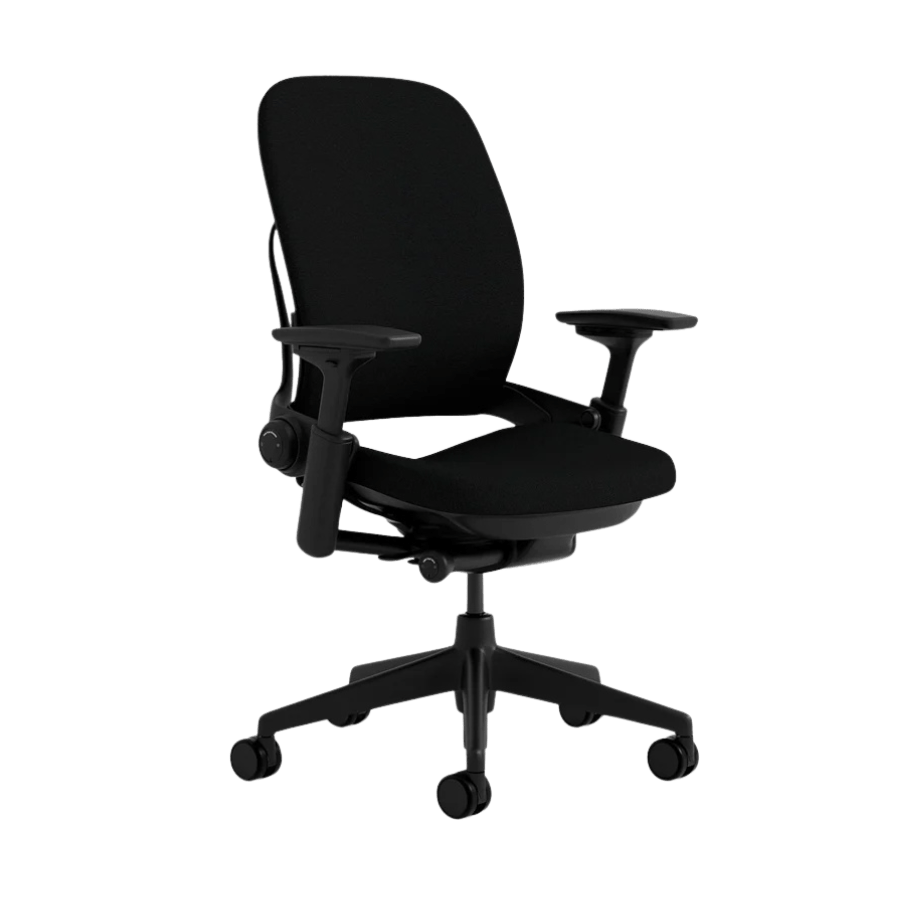
Our pick for adaptive back support you can buy right now is a refurbished Steelcase Leap V2. Steelcase calls the backrest LiveBack, and it bends along with your spine, so the support comes with you from leaning at the screen to slouching back on a call.
- LiveBack: bends with you. No single fixed curve to argue with.
- Lumbar height and lower-back firmness: set these once and you're done.
- Renewed by us: fresh upholstery, new cylinder, new arm pads, new soft-roll casters, and a 5-year mechanical warranty.
Herman Miller Aeron Remastered Chair (Renewed)
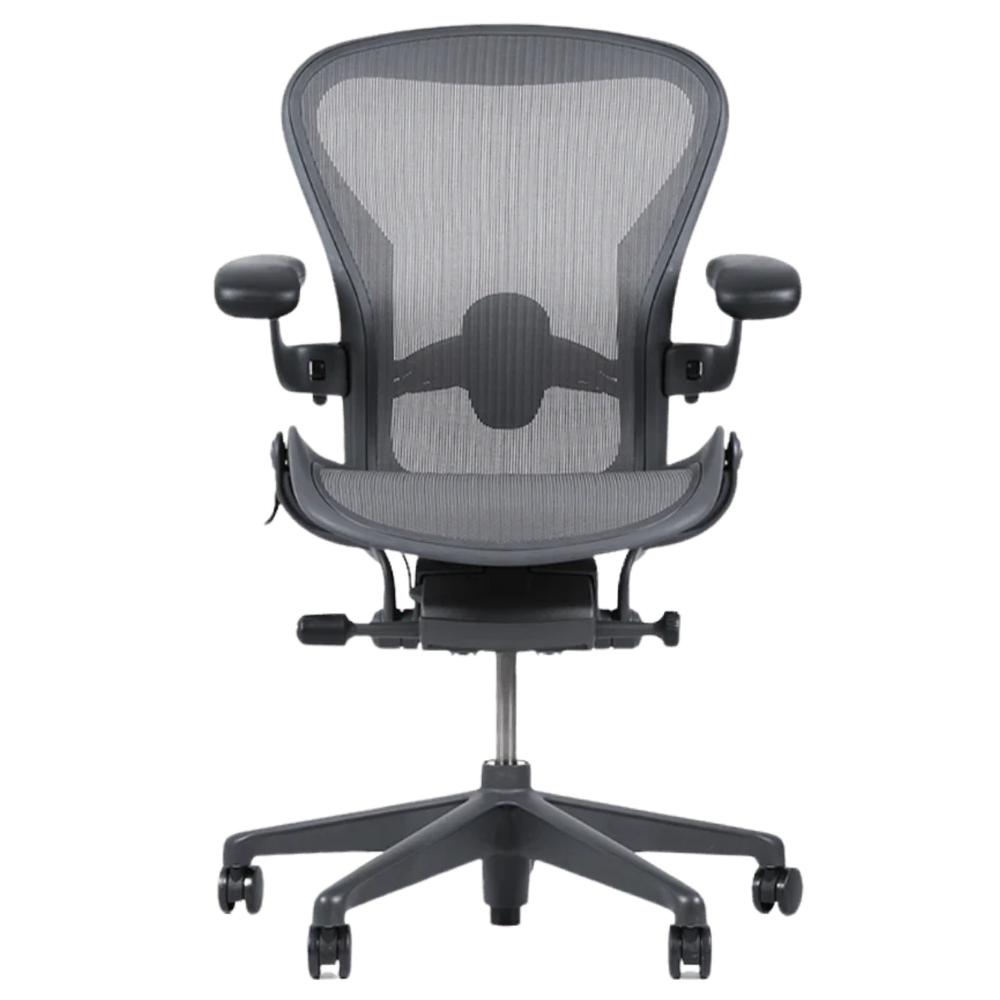
Sit in a Herman Miller Aeron Remastered for a long afternoon and the zoning is what you notice. Its 8Z Pellicle mesh is split into eight bands of different tension, four of them across the back, so some parts of the back hold you tighter and others give a little more. Air moves straight through it too, which helps if you run warm.
- PostureFit SL or a lumbar pad: with PostureFit SL, two pads flex on their own, the lower one for your sacrum and pelvis, the upper one for your lower back.
- Three sizes: A, B and C. Size B suits most people from about 5'3" to 6'0".
- Renewed by us: taken fully apart, deep-cleaned, worn parts replaced, then tested and calibrated, with a 2-year mechanical warranty.
Herman Miller Mirra 2 Chair (Renewed)
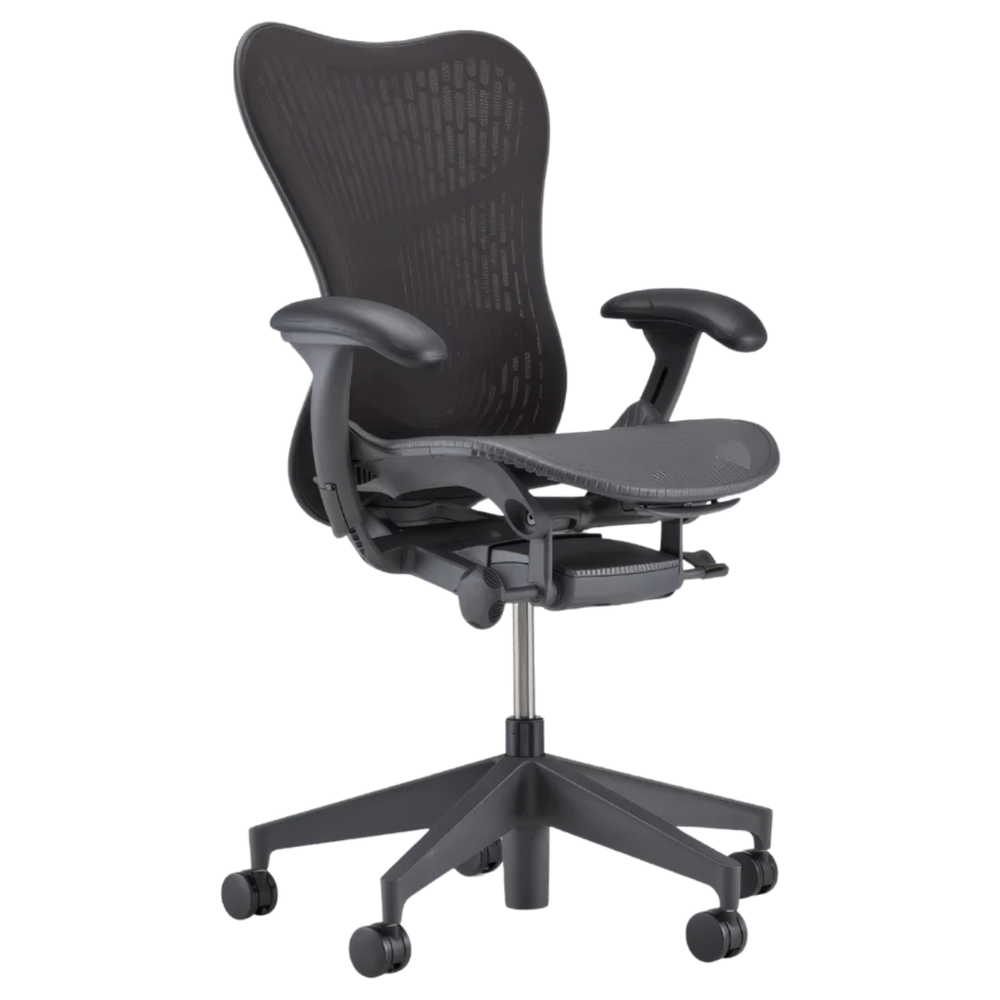
Nothing about the Herman Miller Mirra 2 looks high-tech. Still, its Butterfly back, a flexible polymer frame with suspension fabric over it, bends where your spine wants to bend and holds firm where it shouldn't give. Twist round to grab a file or slump for a minute over an email, and the back goes with you.
- FlexFront: the front of the seat slides, so short and long legs both get proper support.
- Arms pivot and slide to meet your forearms.
- Tilt: a tension dial, plus a lock if you like to stay upright. It holds up to 350 lbs and comes with our 2-year mechanical warranty.
Like the Classic Aeron's heavy-duty build but want the newer touches? The Aeron Hybrid above is the other route. Either way, discover every chair side by side in our ergonomic office chairs collection.
Future of Seating: Your Questions
Are Smart Office Chairs Worth It?
It depends on how you work. Strip the electronics off a smart chair and you're left with a regular chair, so start by judging that part. Sensors bolted onto an average frame won't fix it. Shared desks, an appetite for posture data, or a need for support that adjusts without your help: those are the cases where the smart bits pay off, and they're the jobs we designed our AI chair around. Whatever you pick, ask two questions. What's the warranty, and can anyone fix the electronics?
What is task seating?
In ergonomics, "task seating" is the jargon for the chair you do your real desk work in, hour after hour, with adjustable height, seat depth, back support and armrests. Lounge and guest chairs are for the ten-minute visits.